Culture, Evolution, Perpetual War

Lacoon: The Perils of Knowing

Priest of the Trojans at the time of the Greek invasion, Laocoon is punished by Poseidon for advising his people to refuse the gift of the wooden horse. What power did Laocoon possess that enabled him to see its inner dimension?  What enabled him to recognize danger where others saw only the polished fineness of a practiced art? “Beware of Greeks bearing gifts,” he is reported to have said. At once impressive and pathetic, the life sized figures of Laocoon and his sons–metaphors for all future generations–struggle with the serpents sent by Poseidon as retaliation. Striving to rise, Laocoon is pulled down.  Attempting to break loose, he is confined–snakes coiling round arms and thighs ever more tightly, so that no amount of effort can set him free.  Around him, the citadel of Troy erupts into flames.  Its people shall soon be slaughtered, or marched into ignominious captivity.  It has  happened before.  Often.  It is also happening now:  In Gaza. Rescued from the [...]

Lacoon: The Perils of Knowing2026-02-22T08:45:55-08:00

Ascending Descending: Masters of Delusions

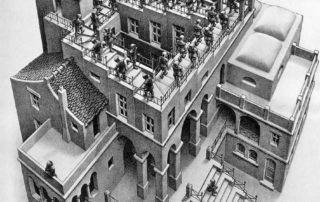
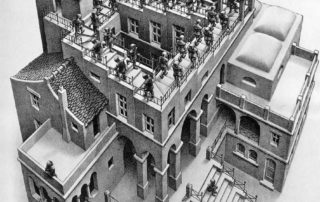
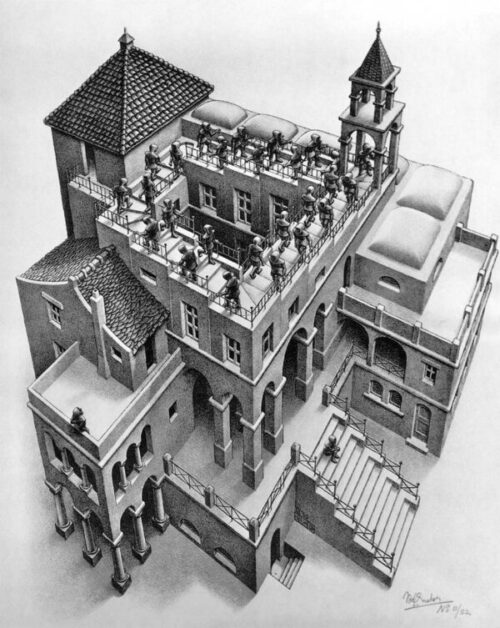
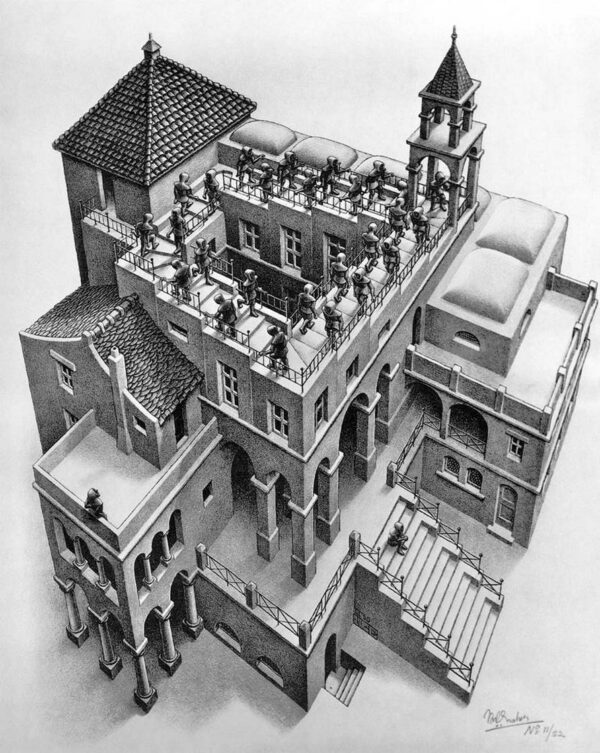
Prisoners of a closed universe from which there is no escape, Escher’s monks climb an ever-upward, ever-downward staircase. No matter how many steps they take, their trance-like, persistent tread will only return them to the point where they began. As is often the case with the dream-work of an artist such as Escher, the familiar is suffused with a playful element of indeterminacy. His technique verges on the surreal when, for example, he draws a hand that draws a hand that appears to be drawing itself… or when he repeats the outline of a reptile until it suddenly comes to life, slithers briskly to the edge of the page, and prepares to join us in our world. In both cases, the subjects of the illustrations threaten to become uncontrollable extensions of what was only moments ago a hollow outline in pen and ink. Dreams derive both their beauty and their terror from such madness. Many who confront Escher’s Ascending, Descending wonder whether [...]

Ascending Descending: Masters of Delusions2026-02-13T14:11:31-08:00

Post Modern Oedipus: Challenging the Gods

Post Modern Oedipus: Challenging the Gods As the gods evolved from their animistic origins, their powers simultaneously increased. This transformation, engineered by priests and story tellers, ultimately created gods who had human faces, human appetites, human behaviors, and human emotions. They were created in man’s image and likeness–not the other way around. As humans write large, the gods soon acquired families as well as rivalries.  A short list of these exciting opposites/rivalries would include:  Visnnu/Shiva, Ahura Mazda/Ahriman, Osiris/Set, Zeus/Prometheus, Olympians/Titans, Yahweh/Lucifer, Jesus/Satan. And yet, no matter how powerful the priests and their gods became, no matter how exciting their story lines, citizen skepticism and criticism never completely went away.  Was tithing worth it?  Were our sacrifices properly acknowledged?  The priests and temples are becoming richer and richer–are we citizens receiving our fair share? First Rescuing of the Gods The earliest effort to justify the ways of god to man occurred in Sumeria during the second millennium B.C.E. At a loss to explain [...]

Post Modern Oedipus: Challenging the Gods2026-02-19T09:41:27-08:00

How Humans Stumbled Onto the Gods

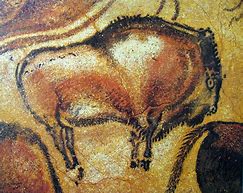
First arising as an attempt to control animal spirits and guarantee future success in the hunt, religion germinated for many thousands of years before it made a regressive leap into the “ethical” future. The journey begins with the cave paintings of Cro-Magnon. Serving a purpose resembling a rain dance, such sketches of hunters and hunted game are humanity’s earliest form of sympathetic magic. This is the shamanic reenactment of a hoped-for event, all in the belief that the future can be put under human control via artistic mimesis (imitation). Crawling on his or her belly, slipping down narrow clefts that separated huge mountains of stone, fording chilly underground streams on all fours, writhing ever inward toward the dark and secret womb of the earth—sometimes a half mile or more from the sunlit entrance—the shaman and his or her artists return to a symbolic womb in order to work their magic. There, engulfed within a placental darkness, they labored by flickering torchlight to [...]

How Humans Stumbled Onto the Gods2026-02-13T14:12:06-08:00

Ecce Homo: Nightmare in Eden

Lord of the Flies Surveying the savage disintegration of their temporary island paradise, Piggy asks Ralph: “What makes things break up like they do?” Identifying the source of Evil has dominated religious discussion for centuries. And for those same centuries our best thinkers have attempted to find an answer while using the same faulty equipment. Evacuated from a world at war, a group of English boarding school youths find themselves abandoned on an Edenic tropical island. The crash that brought their plane down has killed the crew members–the only adults accompanying them on the journey to escape. At first the boys celebrate their freedom from adult restraints, and for a brief moment are presented with an opportunity to create a paradise that previous adult generations have never been able to achieve. Their early enthusiasm soon gives way to increasingly sinister bickering between two natural leaders, as well as to the discovery that not only are they alone on the island, but also [...]

Ecce Homo: Nightmare in Eden2026-02-13T14:34:19-08:00

Erda’s Ring: Sleep Tight, Wotan

The great wheel spins, turns away from itself, twisting the strands of moments into one continuous thread of time.  The shuttle clatters as the thread–always the same thread–is worked into the tapestry of life. Camped by the great world tree Ygdrassil, the Norn sisters weave the fabric of the future: A Wyrd that is clear and predictable to any who might read it.  Held fast within its warp and woof, each of us appears on the tapestry.  See the tightly spun threads of our lives plotted, calculated and projected into the future. Moira is one of the many names for the destiny that rules both men and gods.  This allotment cannot be resisted:  it will bring mortal Oedipus to ineluctable ruin, and it will make a much later Macbeth wish he had never encountered the Wyrd Sisters. Not even the gods are safe from its operations.  As Aeschylus shows us in his Prometheus Bound, even Zeus himself will be unable to “shun [...]

Erda’s Ring: Sleep Tight, Wotan2026-02-13T14:34:37-08:00

Prometheus, Satan & Jesus

Whether the universe is the intentional work of a designer, or whether it is the result of a blind, spectacular concatenation of unknown processes, cannot be known. Perhaps only atheists would be satisfied with the latter choice.  Atheists do not clamor for cosmic certainty,  they do not pray for salvation, neither do they hang their hopes on the existence of an eternal life.  It is enough to enjoy the awe and majesty of existence on its own merits.  It is enough to accept that death is merely a return to the darkness from which we all first emerged.  In the words of Dylan Thomas: "...Wise men, at their end, know Dark is right." Such a conclusion is not satisfying for most people.  After all, it is difficult to snuggle up to a blind, careless universe:  a  phenomenon that cannot be understood, that cannot be communicated with, that cannot be placed under some measure of human control. They know that a belief in [...]

Prometheus, Satan & Jesus2026-02-13T14:38:21-08:00

This Mortal Coil

A Just So Story… Mind and Body are the inventive, but odd couple of evolution. One rides high, head sometimes in the clouds. The other pushing off heroically in pursuit of newly discovered strategies that maximize fitness. Together they swam, slithered, trotted or stumbled forward through the eons, undergoing the costume and scenic changes scripted by chance, death and change: as filter feeders, as bloodsuckers, as toothy sets of murderous jaws: now amphibian, now reptilian, and most recently as mammal, elaborating upon the digestive tube format in myriad variations until, together, they arrived at last as Homo Sapiens: the threshold of the modern world. As we survey the myriad transformations leading to us, we gain a profound appreciation for the useful Mind and its Bodily master. From within the prison of the skull, Mind directing our activities from afar, somewhat like a NASA technician guiding a Lunar Lande safely to the surface of the moon. Along the way they devised hunting strategies, [...]

This Mortal Coil2026-02-09T16:08:42-08:00

Raft of Medusa: Death of a Salesman

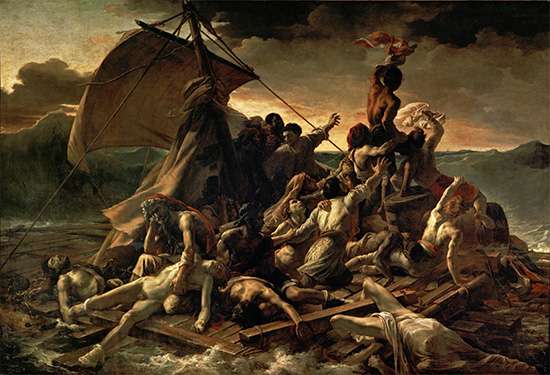
A fragile vessel bobs like a sodden cork beneath heavily threatening clouds.  Some of its passengers are resigned, others near to expiring, and still others are intent on keeping watch, perhaps believing in the imminence (or immanence) of rescue.  They have gathered at what they believe to be the front of the raft, near a makeshift mast.  But they have no rudder to steer by. Great blasts of wind impel them in the opposite direction from that which they imagine their rescue might come.  A dead man, his legs dowsing the surface of the shark filled sea, leads them on their way. Is life a chaos without a center; a pointless journeying toward annihilation?  Is no one is ever safe; does anyone ever arrive? Journey within a journey, the ticket mislaid or lost; the gate inaccessible the boat always pulling away from the rickety wooden dock; the children waving… (Roethke) Humankind’s first journey–the frantic stampede of single cells pushing forward into the [...]

Raft of Medusa: Death of a Salesman2026-02-13T14:34:51-08:00

Hamlet: Into the Abyss

The foregoing discussion has emphsized a phylogenetic and unconscious etiology for the problem of history.  But there is a related set of explanations to contend with–a set which focuses on the human need to escape the unconscious terror of finitude, impermenence, and mortality.  This view was masterfully knit togetheer by Ernest Becker in his epochal The Denial of Death.  This invisible and ubiquitous terror is almost always screened from human consciousness.  Yet invisible though it may seem to be, it is the central driver for the cultural behaviors that continue to kneecap human progress. Its overwhelming presence can is most easily detected in all of the arts--especially tragic drama, and with poetry. As such, it begins precisely where the following stanza ends: I dream of journeys repeatedly: Of flying like a bat deep into a narrowing tunnel, Of driving alone, without luggage, out a long peninsula, The road lined with a snow-laden second growth, A fine dry snow ticking the windshield, Alternate [...]

Hamlet: Into the Abyss2026-02-13T14:38:45-08:00

Panopticon: Welcome to Your Portable Prison

Santayana was wrong. History does not repeat itself because we have failed to learn from the past. History repeats itself because evolution and its phenotypic servants--culture and reason--have been structured to preserve the pugnacious,  conservative behaviors that guaranteed human survival. These inheritances are the invisible prison into which human is born; a prison that prevents an unmediated encounter with experience and the world.  A prison that prevents us from accepting, and reconciling with, our mortality.  For millennia they have maximized our fitness in the game of life.  They cannot be surpassed because they are what we are. For milennia they have pulled hard at the reins of a reality-testing self.  They continue to steer the human reason into childish mis-identifications and shoaling behaviors that prevent emancipating breakthroughs.  As Schopenhauer understood, in the contest between Reason and the Will there is no contest. As one ages one may elaborate a few variations on life’s floor plan–adding a wing here, a visiting room there, [...]

Panopticon: Welcome to Your Portable Prison2026-02-13T14:35:07-08:00

Dionysus: Stampeding the Gods

Featuring Arthur Miller: The Crucible "I say, I say God is Dead!" John Procter: The Crucible The stories of Orpheus, Demeter, Persephone, Semele, Dionysus and Jesus are derived from Mystery Cults: tales of divine beings who suffer, journey to the underworld, and who are miraculously resurrected to life. Each day, Semektet the Solar Boat, transports Sun God Ra across the 12 hours of the day. When Ra descends into the 12 hours of darkness, Ra dies. Semektet continues on its own, and stops at the seventh hour of the night. The mummies are removed from the solar bark and lined up to be judged by Osiris and his assistant Anubis. Anubis weighs each against the Scale of Maat (righteousness). Those who pass the test receive wings for their flight to Kenta Mientu: the heavenly hunting ground. Those that fail the test are turned over to Apophis, the crocodile who will devour them. Semektet now continues to the 11th hour of the night. [...]

Dionysus: Stampeding the Gods2026-02-13T14:39:04-08:00

Akhenaten or Henry VIII? Hellions or Saints?

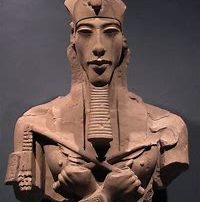
Much like Northwest natives who believed that earth was the the spiritual repository of departed ancestors, we moderns also tread upon the ancients who have preceded us.  The patterns and beliefs of the past are never really surpassed, and new generations merely reiterate the ancient themes and compulsions.   The Hypostyle Hall of Karnak, the minaret, the cathedral, the pulpit or the temple: these architectures are the stony flowers of those faiths that spring from the ancient turf of human vulnerability, reminding us that the secret of all renewal is merely return. But sometimes, even from the crypted heart of the stony past, one can hear a different message: a defiant whisper winking upward through the spiraling centuries.  This whisper informs us that our last ally within the bony prison of the skull has been planning its escape with care.  For good or ill, its unfinished work promises that sometime, somewhere, someday, the proponents of surrender and orthodoxy, like the administrator of [...]

Akhenaten or Henry VIII? Hellions or Saints?2026-02-13T14:39:17-08:00

Bernini: Erotic Religious Seduction

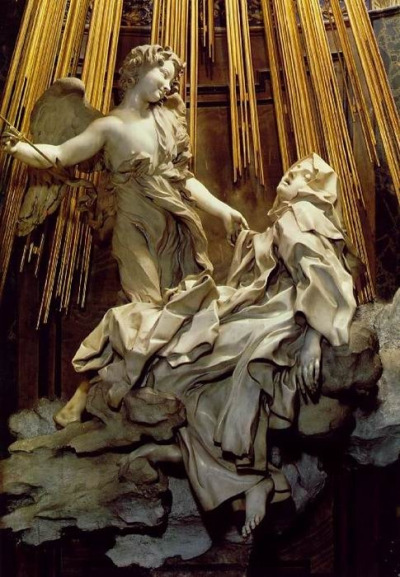
She swoons languidly upon a coral-like bed of dreams that floats above the altar of the Santa Maria della Vittoria in Rome.  Head tilted back invitingly, throat beginning to emerge from a ravishing swirl of polished drapery, Teresa seems about to fall into a perpetual unconsciousness while, poised above her, Cupid thrusts the golden arrow again and yet again deep into her heart. An odd mixture of the erotic and the mystical, of pagan and Christian motif, Bernini’s Ecstasy of Saint Teresa presents us with the archetypal religious image:  the welcome collapse of ego boundaries for world-weary souls; the welcome return to the undifferentiated power and bliss that can only be found at the umbilicus of the world. Golden rays pour downward from the interior of a cervical star and illuminate the repetitive thrust and withdrawal of the phallic arrow.  Teresa appears to slip her moorings; and the rough hewn rock which is her couch–and which is our rasping world– is transformed [...]

Bernini: Erotic Religious Seduction2026-02-13T14:35:22-08:00

Schizo Philosophy: The Sirens Beckon

Socrates final words, uttered from beneath the sheet that he had drawn over his face to hide the poison grimace, were thought to point the way out of humanity’s existential dilemma: Crito, I  owe a cask to Aesclepiius. Please see that the debt is paid. It was the custom in Greece to make an offering at the temple of Asclepius, the god of healing, when one had recovered from an illness. In making this offering of a cock, what Socrates clearly means is that life itself is the illness, and that to die is to recover.  To die is to achieve the long awaited release of the soul from the emprisoning bonds of material existence.  By the time of Socrates, this mystical, religious belief has become rationalized, and its justifications lie snugly bristling behind a delusional facade of brilliant argumentation. A post-modern perspective requires us to approach this impediment to humanity’s reconciliation with the facts of life by first recognizing its incomparable [...]

Schizo Philosophy: The Sirens Beckon2026-02-13T14:35:33-08:00

Mythic Engine of American Culture: Epigenesis of Totemism

"Dogma is the imposing cathedral which lifts its dome above the beliefs and the cults of a highly organized religion, enclosing them and guarding them against the crude reality.  The architects of the Middle Ages believed that such a sacred edifice was consecrated only if a living man was buried under it–a belief from the dawn of religion.  Deep under the floor of the gigantic edifice, which encloses the holiest elements of a religion, an unknown fragment of reality is actually concealed.  There lies buried the omnipotent chieftain of the primeval horde, who was once upon a time murdered by his united sons, and who afterwards became the Almighty God.  Though the pinnacles of the cathedral may soar toward the heavens, its foundations reach down into those depths in which the strongest and most primitive instinctual impulses, the sexual and hostile impulses of humanity, have found their concealed satisfaction.” (T. Reik, 1951) Anthropologists have long noted the ubiquity of the Totem and [...]

Mythic Engine of American Culture: Epigenesis of Totemism2026-02-13T14:39:38-08:00

Plato’s Counter Reformation: Attack on Reality

The successes of both Pythagoras and Plato will ironically open the way for a final skeptical assault on the immortality project itself. Though most evidence about Pythagoras’ life is fragmentary, we do know certain aspects of his philosophy from reports left by his students and successors.  His establishment of a religious order bound by strict rules as to diet and behavior, with his person as the focus; his respect for the ascetic tradition and its anti-materialist bias; and especially as evidenced by his doctrine of the transmigration of souls. The most famous anecdote about his life has to do with his coming upon a man beating a dog with a stick.  Pythagoras rushed to the man and implored him to stop, claiming that in the howl of the abused animal he heard the voice of a friend who had died some time ago. The essence of Pythagorean philosophical doctrine is the belief in the dualism of one and many, of permanence and [...]

Plato’s Counter Reformation: Attack on Reality2026-02-13T15:24:24-08:00

Crazy Old Freud: Tear off the Masks

Introduction to the Epigenesis of Totemism The discoveries of the new sciences hammer away at humanity’s most cherished, delusions.  Galileo set the earth spinning in an intergalactic void; Darwin posited a theory of origins which required oceans of blind, godless time. And still more recently, Freud broke multiple taboos and spoke candidly of bodily orifices, defense mechanisms, primal motivations, and the delusions to which fearful superstition gives rise.  These pioneers and their successors dramatically pushed the cognitive envelope outward, and challenged the magical formulae that had sustained humanity on its journey out of Africa. Freudian theory and psychoanalysis were a products of scientifically confident times.  In that positivist atmosphere, no mystery of the universe was thought to be beyond understanding.  And while this hubris produced a number of false starts, its spirit of bold inquiry opened the the way for later discoveries that were truly profound. Freud described the psyche’s fears, hungers, and fantasies.  He discovered its escape mechanisms; its ability to [...]

Crazy Old Freud: Tear off the Masks2026-02-13T14:36:01-08:00

Why History Must Repeat, Repeat, Repeat

To see a World in a Grain of Sand And a Heaven in a Wild Flower, Hold Infinity in the palm of your hand And Eternity in an hour. (Wm. Blake) William of Champeaux, teacher of Abelard, proposed the idea that the universal is contained in the particular.  To know the little world or microcosm is to know the larger structure of which it is a part.  Ergo: in order to know humanity it is really only necessary to know one individual. Perhaps a modern Champeaux would also argue that one droplet of pond water beneath a microscope would reveal as much about human motivation than an entire library of explanations. True enough, large worlds (macrocosms) derive their characteristics from shammer worlds (microcosms).  The unique character of the constituent parts, or of the tiniest of laws operating at the subatomic level anticipates, structures and shapes the operation of the larger whole.  A man can be reconstructed from an infinitesimal genome, and today’s [...]

Why History Must Repeat, Repeat, Repeat2026-02-13T14:36:15-08:00

Kansas Forever: Finding Your Way Back Home

Man must now embark on the difficult journey beyond culture…The greatest separation feat of all is when one manages gradually to free oneself from the grip of unconscious culture (Edward T. Hall 1976) The universality of our theme is not uncanny. Our inability to break with the errors of the past derives from our creatureliness and from the knee-capping effects of both culture and human evolution. The harsh calculus of survival required us to acquire behaviors suitable for challenging times:  We are hard wired to be competitive and readily pugnacious.  We focus on tracking differences between "mine" and "thine."  We are predisposed to group (herd) think.  We feel kinship principally with our own, less so with Others.  We are cursed with a ridiculously easy susceptibility to indoctrination (E.O. Wilson).  And just as important for group survival, we evolved a ready willingness to surrender to authority and peer pressure. A variety of fears kept us together: fear of sliding backward, fear of exclusion, [...]

Kansas Forever: Finding Your Way Back Home2026-02-13T14:36:31-08:00
Go to Top