
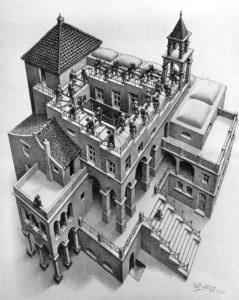
Prisoners of a closed universe from which there is no escape, Escher’s monks climb an ever-upward, ever-downward staircase. No matter how many steps they take, their trance-like, persistent tread will only return them to the point where they began.
As is often the case with the dream-work of an artist such as Escher, the familiar is suffused with a playful element of indeterminacy. His technique verges on the surreal when, for example, he draws a hand that draws a hand that appears to be drawing itself… or when he repeats the outline of a reptile until it suddenly comes to life, slithers briskly to the edge of the page, and prepares to join us in our world.
In both cases, the subjects of the illustrations threaten to become uncontrollable extensions of what was only moments ago a hollow outline in pen and ink. Dreams derive both their beauty and their terror from such madness.
Many who confront Escher’s Ascending, Descending wonder whether to take it seriously at all. A hodgepodge building inhabits a desolate plain; a miraculous staircase turns upon itself like a Möbius strip, spiraling simultaneously upward and downward beneath an airless sky. The only characters in this scene—a handful of obsessive monks—move blindly and zombie-like in their implacable determination to get somewhere. Anywhere.
They remind us of the machines of Chaplin’s Modern Times. They also remind us of a stream of determined ants who continue their compulsive functions despite the obstacle that a malicious child has placed in their path.
From the perspective of an interpreter of the fine arts, Escher’s drawing is a metaphor for the civilizations that human beings have made and presently inhabit.
It represents our world. Not an illusion.
As an architectural chronology, humanity has emerged from a Paleolithic basement, from whence it passed through a Mesopotamian arch. We trace the repetitive steps as they circle through the centuries. Join them now, shoulder to shoulder: up a Persian ceremonial staircase, past Doric columns which support Arabic horseshoe arches, then beneath the sculpted aegis of a medieval parapet. Finally, we enter a Romanesque cella, lit by skylights fit to illuminate a Roman bath. Just ahead lies a void of steps—always the same steps. Waiting.
Here they are—here we are—marching round and round in an effort to add another story to the edifice of human culture. You and I: characters tramping round and round—but never forward—on a repetitive journey into the future.
We now read this work as a metaphor for the absurd cavalcade of human achievement. It collapses human goals and struggles into a narrow frame. As if in fast-forward through the centuries, the cumulative triumphs of human culture—the superficial variety of its architectures—resolve themselves into a claustrophobic, pointless spiral.
Are we moderns as clueless as these persistent monks? Are we as blind as they are to some gravitational force that resides at the core of our collective life? Blind to our compulsion to repeat, as well as blind to the fact that our imaginary “progress” is little more than a constricting circularity?
Witness a humanity reduced to the mechanical, to the thoughtless, and to the reflexive—at once the source of our self-deprecating humor and the source of our most nightmarish visions of ourselves. For no matter how rapidly our conspecifics might build toward the heavens, each of their creations is held fast to the same foundation. But this foundation is not a bridge to the new.
It serves instead as an axle for an apparently purposeless, unconscious rotation.
At its most extreme, it is a sphincter of stone.
“Welcome,” the artist seems to say, “to history.”
What might have been, and what shall be
Point to one end.
Cultural Gridlock
Someone once said, “Read one newspaper…and you’ve read them all.”
And truly, there is either a comforting or an appalling sameness about human history on earth. Change the names, dates, and locales of the headlines of the past and they proclaim but one truth: we moderns know more “things” than did our ancestors, but we are no wiser. We are certainly no better behaved.
Consider:
An ancient psycho-political drama continues to mesmerize the world, just as it did in the days of imperial Rome, Athens, or Babylon. Its persistence reminds us of humanity’s inescapable need for misinformation, groupthink, jingoism, and the perpetuation of the Other against which to marshal its resources and resolve.
When the Soviet–US Cold War wound down, many Americans imagined that they would enjoy an intermission, perhaps even receive a peace dividend. They did not know that imperialistic military adventures had long been permanent features of our foreign policy—not aberrations. They did not understand that the scenery and props for past campaigns were only being rearranged—only being relocated. Not rolled up. Not put away.
In the meantime, small yet painful conflicts served as continuo for an eagerly anticipated “new” main event: six decades of Cuban strangulation; new castes of oligarchic dictators installed with the assistance of the CIA; endless efforts to ensure American hegemony via regime-change shenanigans around the world.
Soon enough, America launched its War on Terror, oblivious to the fact that every “effect” (Twin Towers) has a “cause.” Completely unaware that every accusative index finger pointed at the “Other” is attached to a hand whose remaining three fingers point directly back at the accuser.
Willful denial required equally willful delusion. As a justification for the invasion and destruction of Iraq, America’s leaders “discovered” the existence of phantom WMDs. They also discovered “yellowcake,” certified by Secretary of State Colin Powell’s lies before the United Nations. These lies were uncritically repeated by both the media and Congress and provided a core justification for what was to become a 20-year, $6,000,000,000,000 failure—a failure that brutalized American culture and, more importantly, brutalized the world.
Here at home, the rapid unraveling of American freedoms began apace: automatic renewals of AUMF; unwarranted presidential usurpation of congressional power; the ill-advised creation of an intrusive Homeland Security bureaucracy—the tentacles of which now reach into formerly sacrosanct realms of individual American life.
What will the future bring? Coming attractions now include a renewal of the profitable Cold War with Russia and the so-called “pivot” to the East—a stagger, really—with China cast as the main threat to “freedom and democracy” or to the “rule of law.”
Unfortunately, many of our fellow citizens are relieved that such an exciting moment has arrived. Many are thrilled yet again to enjoy the armchair satisfaction of taking a stand against Evil. Others are overjoyed to have new opportunities to enrich themselves—and to proclaim America’s exceptional greatness to an increasingly disbelieving world. The expenditures required to launch these errors will be astronomical and will again be charged to the people. These expenditures will be readily approved by a servile Congress—including, alas, its so-called progressive wing. And Citizens United, by legitimizing congressional bribery, will ensure the perpetuation of the pattern far into the future.
II: Lonely Are the Brave
Each generation, a new cast of human actors queues boisterously at the banks of the River Lethe to be baptized and then to quaff the muddied waters. Under the spell of forgetfulness, they wade out yet again into the purling, reddish current, pressing forward enthusiastically to commence their own rudderless drift into war.
Old men and women who should know better, and who should warn against this madness, have themselves forgotten the lessons—if ever they learned them. And because they lack the ability or inclination to criticize or persuade, younger generations continue to be inducted into American culture’s maddeningly destructive enterprises.
Naturally, propagandists still ply their hallowed trade, this time spinning electronic variations on field-tested themes. The black arts of the lie and the half-truth have migrated from the chiseled walls of Persepolis and Thebes to the pixel-land of the smartphone and low relief. The hieroglyph of the corporate-controlled news hour is writ so large that millions around the world can now absorb the same official disinformation.
The most blatant forms of censorship are today practiced only by the clumsiest breed of tyrant. In most democracies, censorship has not become extinct; it has merely gone underground. The brutish implements of old-fashioned mind control have given way to a sleek and more insidious form of information deprivation. A government decree is no longer necessary: invisible profit pressures and political pressure conspire to restrict the range and depth of opinion as effectively as once did the clanking of chains or the creaking of dungeon doors.
Quite often now, information is deliberately withheld or canceled outright. If it appears, it is often turned into a one-sided hit piece wherein depth and historical context are deprivileged. The ubiquitous omission of context eviscerates the value of the news. It disarms its audience by stifling indeterminacy and by replacing authentic debate with preapproved text from wire services or from the military–industrial complex.
The field of debate gradually narrows as the unanswered pronouncements of government “experts” become more and more established as truth. A once-broad index of political opinion atrophies—canceled. Inevitably, these views find themselves beyond the imploding pale of legitimate discussion.
So it is that masses of otherwise literate citizens imagine that they think for themselves. But as Bakunin noted, most “only slavishly repeat by rote, with slight modifications, the thoughts and aims of other conformists which they imperceptibly absorb.” They parrot “prejudices elaborated in past centuries, all of which they find ready to take over their lives at birth.”
As Lionel Tiger observed: “Literacy itself was an extremely destabilizing force… Writing was about control; it was about codifying methods of behavior and so on. And now this has become augmented drastically, given the spread of literacy since the Industrial Revolution… Literacy provides leverage for an unprecedented intrusion into formerly intimate and well-integrated societies… And finally, the electronic impact of radio and television, records and satellites makes it possible to market ideologies even more coercively and has added an entirely new and more terrifying dimension to the process.”
Or Robert Trivers: “With the advent of language in the human lineage, the possibilities for deception and self-deception were greatly enlarged. If language permits the communication of much more detailed and extensive information—concerning, for example, events distant in space and time—then it both permits and encourages the communication of much more detailed and extensive misinformation. A portion of the brain devoted to verbal functions must become specialized for the manufacture and maintenance of falsehoods. This will require biased perceptions, biased memory, and biased logic, and these processes are ideally kept unconscious.”
History deceives us. For while it records what seems to be a variety of dramatic changes—revolutions—a troubling number of these are underlain by a paucity of new or paradigm-shattering ideas.
So it is that humanity’s experience with political systems is marked by an obsequious servility to custom and tradition.
A Spider Meditation
The dead are infinitely more numerous and powerful than the living. They govern the immense area of the unconscious, that invisible field that controls the manifestations of intelligence and character. The dead generations impose not only their physical makeup but also their thoughts. They are the only undisputed masters of the living. (Le Bon via Moscovici)
Having bought an abandoned, rundown farmhouse some time ago, I had to spend long summer hours in narrow crawl spaces completing plumbing and wiring tasks. My backside scraping along the dusty, earthen floor, I crab-scuttled beneath joists and corroded pipes that swaled not more than an inch or two above my face.
Once on this journey I pushed into a dense thicket of spider web. I shuddered involuntarily as it shrouded my ears and forehead, and I carefully freed my arms to brush it away.
The wave moves, but the wave remains the same:
And the dead hand leads the past,
Leads them as children and as heir
Onto the blindly tossing tops;
The centuries throw back their hair!
And the old men sing from newborn lips…
Time is bearing another son!(Dylan Thomas)